Please help us improve our records by providing feedback.
Collection of Personal Information
Personal information provided on this form is collected and used for the purposes of responding to feedback, updating our records (e.g. making suggested edits) and communicating with you about related matters.
Personal information, as defined by Section 2 of the Municipal Freedom of Information and Protection of Privacy Act (MFIPPA), is collected under the authority of the Municipal Act, 2001, and in accordance with the provisions of MFIPPA.
If you have questions about the collection, use and disclosure of this personal information, please contact the City’s Information and Access Coordinator by phone at 519-822-1260 extension 2349 or email privacy@guelph.ca.
Images
1 of 1977
Image Request Form
Please fill out this form to request an image and click the Submit Request button when done. Museum staff will contact you to confirm the details of your request.
Image Price List
1-2 digital images without watermark $10.00 each
3 or more digital images without watermark $7.00 each
Processing fee (per order not image) $2.50
13% HST charged on all Canadian orders
Collection of Personal Information
Personal information provided on this form is collected and used for the purposes of processing image requests, administering image reproduction agreements and communicating with you about related matters.
Personal information, as defined by Section 2 of the Municipal Freedom of Information and Protection of Privacy Act (MFIPPA), is collected under the authority of the Municipal Act, 2001, and in accordance with the provisions of MFIPPA.
If you have questions about the collection, use and disclosure of this personal information, please contact the City’s Information and Access Coordinator by phone at 519-822-1260 extension 2349 or email privacy@guelph.ca.
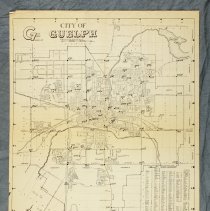
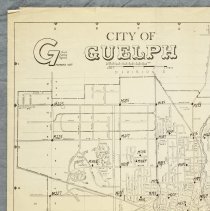
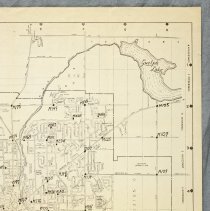
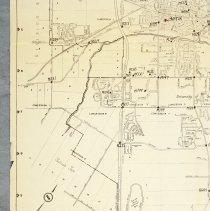
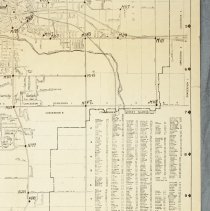
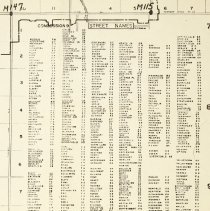
The map depicts street names (with a index at bottom right), divisions, concessions, railways, and the proposed Hanlon Industrial Park. There are hand written four-character codes and accompanying dots at various points across the map in black ink. MTOR's dot at the corner of Yorkshire and Waterloo Streets has been crossed out and redrawn at the corner of Fergus and Waterloo Streets in pencil and circled in red, with an arrow to denote the change.
Stylized "G" in top left with Guelph's motto "Faith, Fidelity, Progress" printed to its right.
Notes
Mapmaking is an ancient, global, and subjective practice. Maps can help us to understand land relationships over time. It is important to understand why a specific map was made, whose interests it reflected, and how it was intended to be used. These understandings are shaped by knowledge of the land from diverse perspectives, past, present, and future.
Historical Context:
Early Indigenous navigational maps of the place we now call Canada were drawn on impermanent materials, accompanied by verbal descriptions and committed to memory. Landmarks were accentuated to aid travellers and scale was often measured by time (such as, a day's journey).
In about 1502, European mapmakers depicted the east coast of Newfoundland as an island in the North Atlantic. World maps skewed the size and shape of continents and used colour to symbolize colonial powers. The first surveyors measured and marked plots of land - taken, traded, granted, or sold - often naming the landholders on the map.
Today, the science and practice of mapmaking documents the topography of the landscape in fine detail, through aerial photography, sensors, satellites, and global positioning/information systems (GPS/GIS).
 Explore the Collections